
The Library Built by Fire: Inside the World’s First Central Server
May 26, 2026.

If you were a king in the 7th century BCE, your resume was judged by a very specific, bloody standard. You bragged about the cities you burned, the enemies you impaled, and the empires you crushed under your chariot wheels.
Podcast analysis of essay…
The Neo-Assyrian Empire was particularly famous for this kind of brutal marketing. But around 668 BCE, a ruler named Ashurbanipal took the throne in Nineveh, and he decided to add a bizarre new flex to the royal brand.
He bragged about his high test scores.
Alongside the standard inscriptions about hunting lions and defeating rival kings, Ashurbanipal released official royal edicts proclaiming his ability to solve complex mathematical equations, read ancient, dead languages like Sumerian and Akkadian, and debate philosophy with top scholars. He was history’s first terrifyingly powerful nerd.
But his ultimate legacy wasn’t a military victory. It was an obsession. Ashurbanipal set out to do something no human had ever attempted: to gather a copy of every single piece of knowledge on Earth and store it under one roof.
He built the world’s first systematically organized royal library. And by a strange twist of fate, the catastrophic destruction of his empire is the exact reason his library survived to rewrite modern history.
The Ultimate Overdue Book Policy
To build his central server of human knowledge, Ashurbanipal didn’t just sit in his palace and wait for donations. He deployed what can only be described as scholarly acquisition teams across the Middle East.
We still have the surviving letters where the King writes to his regional agents, commanding them with the urgency of a modern tech CEO: ”Search for valuable tablets that are in your archives... hunt for rare tablets that are known to you but do not exist in Assyria, and send them to me immediately!”
When these tablets arrived in Nineveh, a massive bureaucratic machine took over. The library was staffed by an elite, highly specialized class of scribes, scholars, and curators. These weren’t just passive copyists; they were the original IT department.
If a rare text arrived from an old, crumbling temple in Babylon and parts of it were faded or broken, the scribes didn’t guess. They would meticulously reconstruct the text using comparative linguistics, and at the bottom, they would write: ”Copied from an old original, collated, and checked.” It was a system built on strict academic peer review.
Furthermore, Ashurbanipal was fiercely protective of his collection. At the bottom of many tablets, the scribes stamped a standard royal note—a colophon—that acted like a terrifying Terms of Service agreement. The text literally warned that if anyone stole a tablet, defaced it, or failed to return it to the library, the gods would “cast you down” and “erase your name and your seed from the land.” If you think a library fine is bad today, imagine history’s first librarian placing a literal death curse on your entire bloodline because you forgot to return a book on astronomy.
Inside the Server Room
The library eventually grew to hold tens of thousands of texts, and it required a radical new way of organizing information. Because they were dealing with clay tablets rather than book spines, the scribes invented a physical data-management system:
The Shape-Coded Data: Flat, four-sided tablets were strictly reserved for financial transactions and government administration. Round, curved tablets were used exclusively for agricultural data and livestock tracking. A scribe could glance into a basket and instantly know the format of the data inside.
The “Dewey Decimal” Rooms: Rooms were organized by subject matter—law, medicine, history, and magic. But since there were no titles, texts were cataloged by their incipit meaning; they were filed in the master directory by the very first words of the story. It is the exact same logic your computer uses today when it names an untitled document after its first line of text.
Ancient Data Compression: Space was limited, so Assyrian scribes perfected microscopic cuneiform writing. Some of the tablets contain characters so incredibly tiny that modern archaeologists have to use magnifying glasses to read them. Scholars believe the scribes were using primitive magnifying lenses made of polished rock crystal to pack as much data as humanly possible onto a single block of clay.
Inside these rooms sat an astonishing cross-section of the human mind: planetary tracking data from astronomers, pharmaceutical recipes for the sick, tax ledgers, diplomatic treaties, and exorcism rituals to drive away demons.
The 2,600-Year Accidental Backup
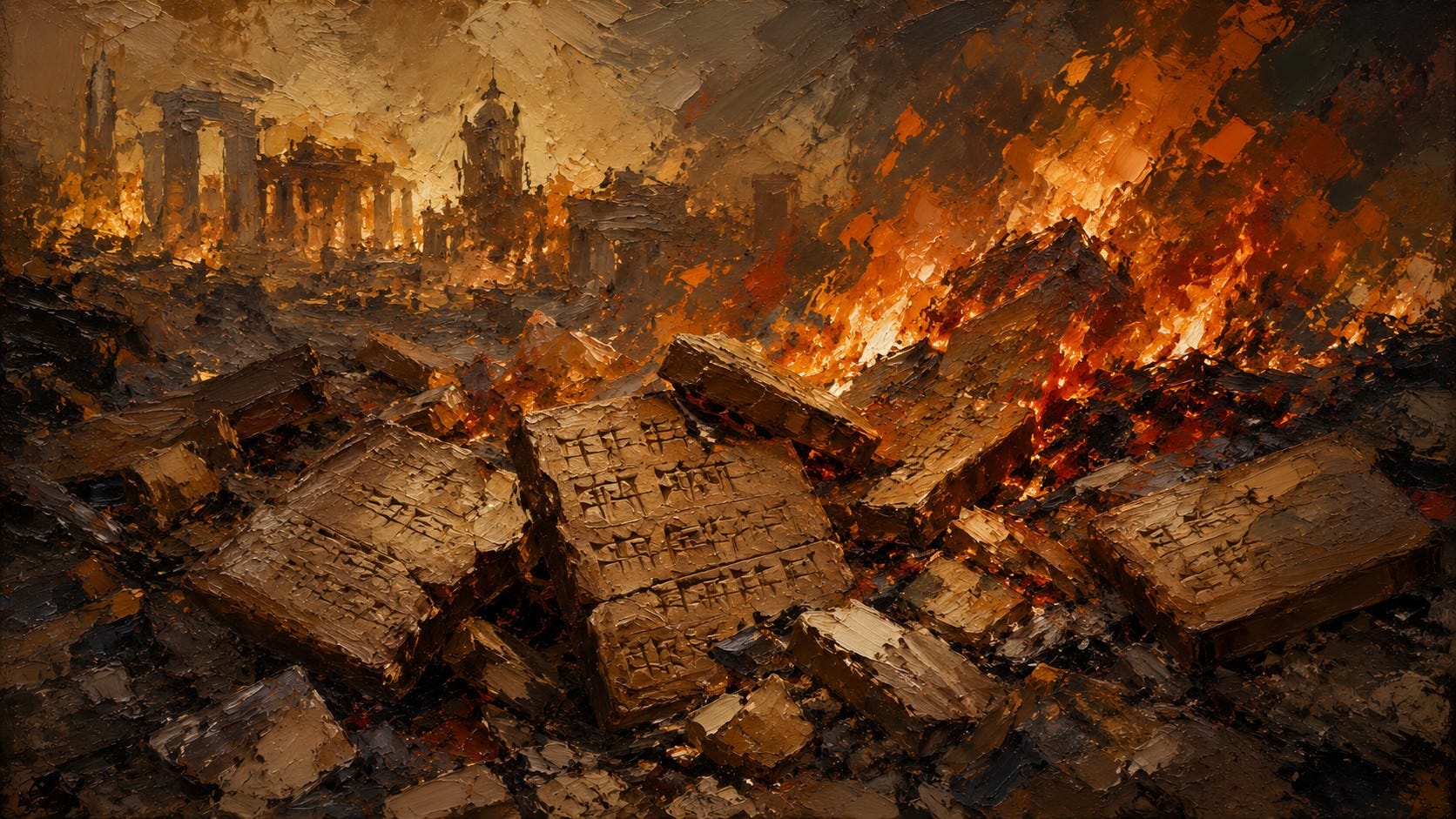
In 612 BCE, the dream came to a crashing halt. A massive coalition of Babylonians and Medes marched on Nineveh. The city was brutally sacked, the palaces were plundered, and Ashurbanipal’s grand library was torched. The wooden shelves collapsed, and tens of thousands of clay tablets crashed into the blazing, smoking ruins of the basement.
The civilization was gone. The empire faded into memory. But here is the magnificent irony: the fire didn’t destroy the library. It saved it.
Had the Assyrians written their knowledge down on papyrus, leather, or paper, the flames would have turned the world’s first library to ash in minutes. But they wrote on wet clay. The intense, catastrophic heat of the enemy’s inferno acted as a giant kiln. It accidentally completed the manufacturing process, baking the clay tablets rock-hard into indestructible ceramic and sealing them safely beneath layers of protective ash for the next 2,600 years.
The Day History Exploded
When Victorian archaeologists finally dug up the ruins of Nineveh in the mid-19th century, they found thousands of these perfectly preserved ceramic pages. But they didn’t just discover an Assyrian archive; they had accidentally cracked open a portal to a completely forgotten chapter of human history: the Sumerian civilization.
The Sumerians were the true pioneers of Mesopotamia — the people who invented the wheel, irrigation, and cuneiform writing itself thousands of years before Ashurbanipal was even born. Over time, their empire faded, their cities were buried, and their language became a “dead” tongue studied only by elite scholars. But because Ashurbanipal was obsessed with preserving the deep past, his library contained countless meticulously copied and translated Sumerian texts.
The true impact of this find exploded into the public consciousness in the 1870s, thanks to a self-taught print-editor named George Smith. He was sorting through the library’s mythological tablets at the British Museum when he began translating a broken piece of a text we now know as the Epic of Gilgamesh — a masterpiece of ancient Sumerian literature.
As Smith decoded the cuneiform, he realized he was reading a deeply ancient Mesopotamian story about a global flood, a chosen survivor, a massive ark like vessel filled with animals, and a sequence where the protagonist sends out a series of birds to look for dry land.
The text predated the oldest biblical manuscripts by centuries. The discovery completely stunned the Victorian world, triggering massive debates about how stories migrate, evolve, and blend across deep time. By preserving the literary brilliance of the Sumerians, Ashurbanipal’s library didn’t just save Assyrian records; it restored the foundational roots of human literature and proved that our shared cultural heritage belonged to a much deeper, more interconnected continuum than anyone had ever guessed.
A Message in a Bottle
There is something deeply haunting about walking through the ghost of Ashurbanipal’s server room. A king living nearly three millennia ago attempted to back up the total sum of human memory—our fears, our science, our myths, and our ledger books and then his entire world burned to the ground.
Yet, beneath the ash, the data waited.
The Library of Ashurbanipal matters because it shatters the arrogant modern assumption that ancient people were intellectually primitive. They were just like us: organizing data, managing logistics, and trying to make sense of a volatile universe.
More than anything, those baked clay tablets serve as a message sent across deep time… a quiet, powerful reminder that while empires always fall and cities always burn, humanity’s desperate urge to remember will strive to find a way to survive the fire.

You always write very interesting columns.
I don't where you find this old history stuff, but it's fascinating.