
Apartheid's Chaos
June 1, 2026. Album - A Tale Untold

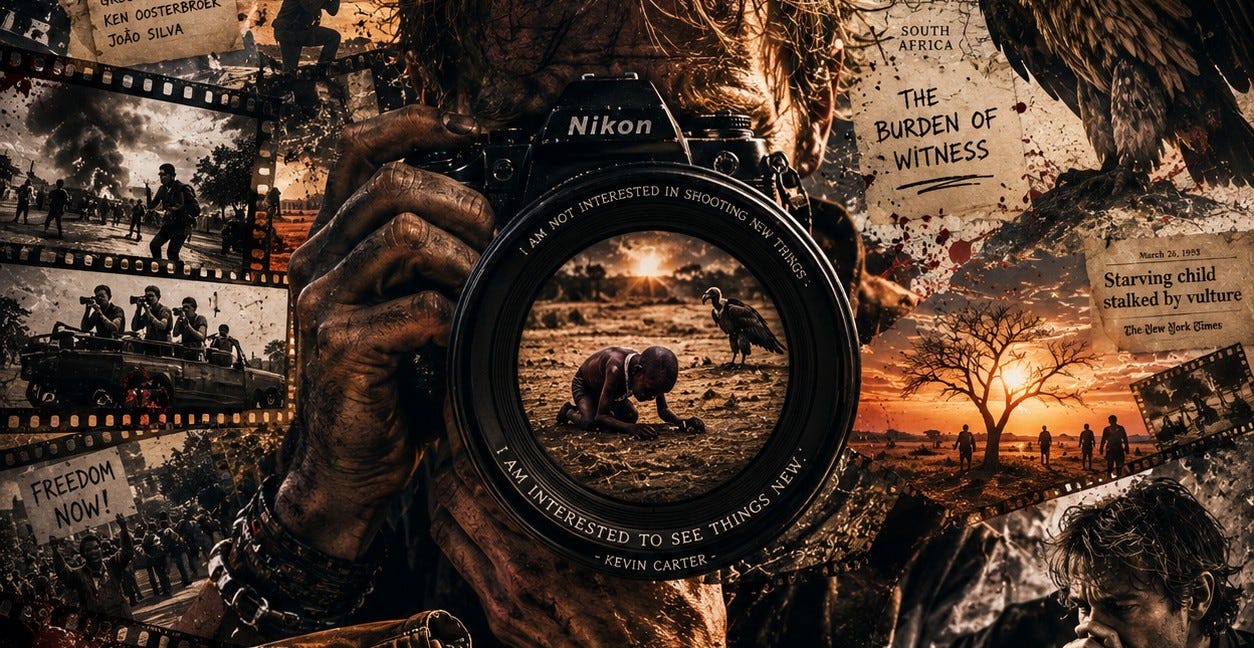
Inspired by the life and experiences of photojournalist Kevin Carter, "Apartheid's Chaos" explores the burden of bearing witness to human suffering. Through the lens of a camera, Carter documented some of the most harrowing moments of apartheid era South Africa and famine stricken Sudan, producing images that shocked the world while leaving deep scars on the man behind the viewfinder. This song examines the uneasy space between observer and participant, asking difficult questions about ethics, responsibility, and the personal cost of documenting history's darkest chapters.
Apartheid’s Chaos
Written by eddie and Claude
[Verse 1]
First day on the job, camera in hand
Apartheid's chaos, I take my stand
Bang-Bang Club, we're four deep
Capturing truths that make the world weep
Adrenaline pumping, I frame the shot
Bullets whizzing by, but I can't be caught
This lens my weapon, film my ammo
Exposing the struggle, frame by frame, yo
[Chorus]
Click, click, the story's told
But the weight of these images, it takes its toll
Through my viewfinder, history unfolds
Each snapshot I take, a piece of my soul it holds
[Verse 2]
Sudan's burning sun, vulture's patient stride
Starving child crawling, death by her side
Finger on the shutter, mind in a haze
Twenty minutes waiting, guilt-ridden daze
Pulitzer in the bag, but at what cost?
Ethics vs. duty, I'm feeling lost
World's judging eyes, they don't understand
The burden of bearing witness in this unforgiving land
[Chorus]
Click, click, the story's told
But the weight of these images, it takes its toll
Through my viewfinder, history unfolds
Each snapshot I take, a piece of my soul it holds
[Bridge]
("Did you help the child?")
("How could you just watch?")
("You're making a difference")
("But at what cost?")
Voices in my head, they won't let me rest
Was I a vulture too? Put me to the test
Capturing death, but did I cause it?
The line between observer and participant, I've crossed it
[Verse 3]
Nightmares won't stop, images burned in my brain
Accolades pile up, but they don't ease the pain
Oosterbroek's gone, caught in the crossfire
My mind's a warzone, depression growing dire
Cameras can't capture the demons inside
The weight of the worlds I've witnessed, nowhere to hide
Bang-Bang Club's legacy, it comes with a price
In the end, it's my soul I've sacrificed
[Chorus]
Click, click, the story's told
But the weight of these images, it takes its toll
Through my viewfinder, history unfolds
Each snapshot I take, a piece of my soul it holds
[Outro]
The final frame, my story complete
The world keeps turning, but I admit defeat
(I'm sorry I didn't make it)
(But I admit defeat)

The Bang Bang Club book link …
https://www.goodreads.com/en/book/show/271543.The_Bang_Bang_Club
“Most people, upon hearing gunfire, would run away and hide. Conflict photojournalists have the opposite reaction: they actually look for trouble, and when they find it, get as close as possible and stand up to get the best shot. This thirst for the shot and the seeming nonchalance to the risks entailed earned Greg Marinovich, Joao Silva, Ken Oosterbroek, and Kevin Carter the moniker of the Bang-Bang Club. Oosterbroek was killed in township violence just days before South Africa's historic panracial elections. Carter, whose picture of a Sudanese child apparently being stalked by a vulture won him a Pulitzer Prize, killed himself shortly afterwards. Another of their posse, Gary Bernard, who had held Oosterbroek as he died, also committed suicide.
The Bang-Bang Club is a memoir of a time of rivalry, comradeship, machismo, and exhilaration experienced by a band of young South African photographers as they documented their country's transition to democracy. We forget too easily the political and ethnic violence that wracked South Africa as apartheid died a slow, spasmodic death. Supporters of the ANC and Inkatha fought bloody battles every day. The white security forces were complicit in fomenting and enabling some of the worst violence. All the while, the Bang-Bang Club took pictures. And while they did, they were faced with the moral dilemma of how far they should go in pursuit of an image, and whether there was a point at which they should stop their shooting and try to intervene.
This is a riveting and appalling book. It is simply written--these guys are photographers, not writers--but extremely engaging. They were adrenaline junkies who partied hard and prized the shot above all else. None of them was a hero; these men come across as overweeningly ambitious, egotistical, reckless, and selfish, though also brave and even principled. As South Africans, they were all invested in their country's future, even though, as whites, they were strangers in their own land as they covered the Hostel wars in the black townships. The mixture of the romantic appeal of the war correspondent with honest assessments of their personal failings is part of what makes this account so compelling and so singular among books of its ilk. – J. Riches”